
 L R Bureau
100 Years of RSS
The Untold Chapter: Beyond Ideology
Patel, Golwalkar, and the RSS Connection
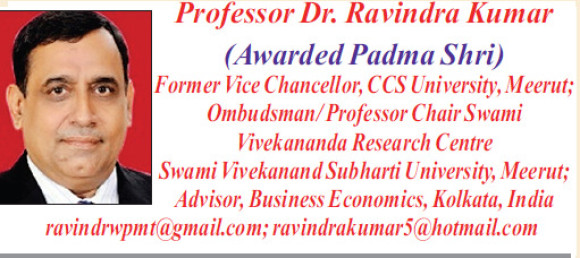
Guest Editor
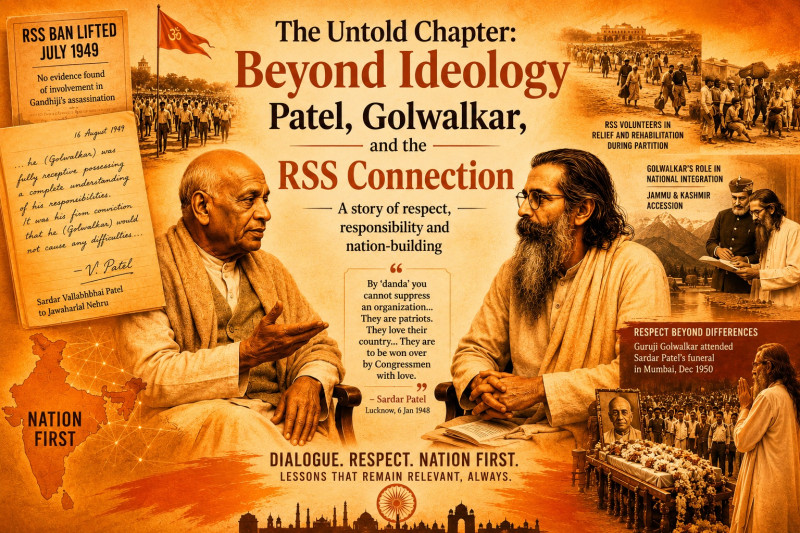
After the assassination of Mahatma Gandhi, a ban was imposed on the Rashtriya Swayamsewak Sangh (RSS) in February 1948; the ban was lifted in July 1949. One month after the ban was lifted, Shri Madhavrao Sadashivrao Golwalkar (affectionately known as Guruji), the Sarsanghchalak, met with Sardar Patel in New Delhi in August 1949. Immediately after his meeting with Golwalkar, Sardar Vallabhbhai Patel wrote a letter to Pandit Jawaharlal Nehru on August 16, 1949, mentioning therein that Golwalkar was fully receptive and possessed a complete understanding of his responsibilities. It was his firm conviction that Golwalkar would not cause any difficulties.
These aforementioned words of Sardar Patel serve as a beautiful testament to the personality of the Sarsanghchalak and his profound sense of responsibility toward the nation. Furthermore, these words underscore Golwalkar's unwavering resolve to ensure that the nation remains free from difficulties under any and all circumstances.
Patel's sentiments toward Golwalkar should, in fact, be viewed in the context of his attitude toward the Rashtriya Swayamsewak Sangh (RSS). Sardar Patel deeply appreciated the Sangh's organizational structure, patriotism, and spirit of service. He was aware of the role, contribution, and significance of the Sangh in the cultural upliftment of India. Consequently, he regarded the Sangh as essential for the country.
He was impressed by the relief and rehabilitation work undertaken by Sangh volunteers, especially for refugees arriving from across the border (Pakistan side) following the Partition of the country. Therefore, Patel wanted the RSS to join the Congress with a bigger role. On January 6, 1948, at a public meeting in Lucknow, he said, "I invite the RSS to join the Congress... I realize that they are not actuated by selfish motives, but the situation warrants that they should strengthen the hands of the Government and assist in maintaining peace."
There was a deep meaning in the above-mentioned call of Sardar Patel. It hinted at the Sangh's future role in the country.
With their wisdom, understanding, and thoughtfulness, as opposed to the aggression and knee-jerk reactions that were natural among the youth of the Sangh in the circumstances of that time (especially those created by the inhuman atrocities on Hindus on the Pakistan side after the Partition of the country), Sardar Patel expected them to act strategically.
In the same public address in Lucknow, he also clearly stated, "In the Congress, those who are in power feel that by virtue of authority they will be able to crush the R.S.S. By 'danda' you cannot suppress an organization. The use of 'danda' will not help... After all, R.S.S. men are not thieves or dacoits. They are patriots. They love their country... They are to be won over by Congressmen with love."
Overall, Sardar Patel viewed the Sangh, under the leadership of Shri Golwalkar, as a patriotic and beneficial organization. He was also impressed by Shri Golwalkar's individual role during the process of national integration, especially regarding the accession of the State of Jammu and Kashmir to the Indian Union, which included Golwalkar visiting the State and meeting Maharaja Hari Singh to persuade him to join the Indian Union.
The ban imposed on the Sangh following Mahatma Gandhi's assassination was enacted during Sardar Patel's tenure as Home Minister. But the ban was subsequently lifted also during the same tenure after no direct role of the Sangh in the assassination was found. The entire series of events is recorded in the pages of our contemporary history; therefore, I do not wish to elaborate on this matter.
Sardar Saheb was a towering leader of the Congress; from an organizational perspective, he was even more influential than Gandhiji. Differences of opinion between him and Shri Golwalkar regarding ideology and methods of functioning were natural. Despite this, Sardar Patel considered the Sangh essential for the country; Sarsanghchalak Shri Golwalkar respected him deeply and acknowledged him as a great national leader. I would like to present two examples in this regard so that the present generation—especially the youth—may become acquainted with the truth.
First, regarding the need for the Sangh in the country: this dates back to 1949 or 1950. Kakasaheb (Narhar Vishnu) Gadgil had taken his son, V.N. Gadgil, to Sardar Patel's Delhi residence (1, Aurangzeb Road) to seek the Sardar's blessings. V.N. was dressed in the uniform of the Congress Seva Dal, which bore a striking resemblance to that of a Sangh Swayamsewak (volunteer). After meeting the Sardar, both Kakasaheb and V.N. were stepping out of the room—accompanied by the Sardar himself—just as Pandit Ravishankar Shukla (then the Head of the Government of Central Provinces and Berar) was entering to meet the Sardar. They all came face to face.
Upon seeing V.N. Gadgil's attire, Shukla asked Kakasaheb, "Is your son in the Sangh?" Kakasaheb replied, "No, no; this is the Congress Seva Dal uniform." To this, Sardar Patel remarked, "Even if it were the Sangh uniform, what would be wrong with that? The Sangh is a necessity for the country." V.N. Gadgil himself narrated this anecdote to me regarding Vallabhbhai's perspective on the Sangh.
Sardar Patel passed away in Mumbai on December 15, 1950. It was Shri Golwalkar's earnest desire to attend the funeral of the Sardar—the architect of the nation's unity. Accompanied by Pandit Shukla, then Head of the Government of Central Provinces and Berar, he traveled from Nagpur—which was both the Sangh headquarter and the provincial capital—to Mumbai to attend the funeral and pay his heartfelt tributes to the Sardar. Such was the respect he held for Sardar Patel.